Door categorieën bladeren
Ontdekken
Fiverr Pro
Nederlands
$
USD
Verenigde Staten
1 bestelling voltooid
AI system Engineer, The Expert for your Automation needs
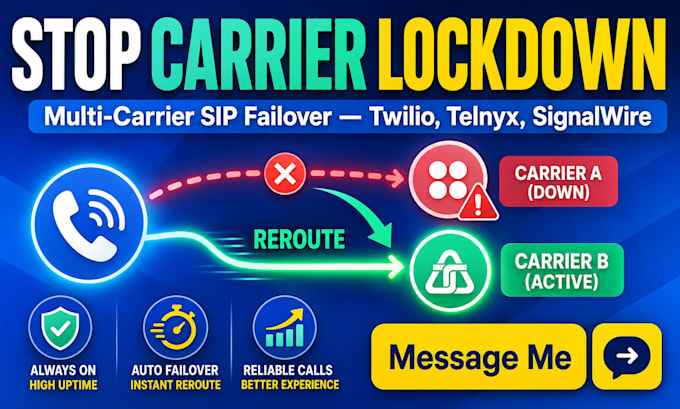
Locked into one carrier's pricing and outages?
WHAT YOU GET:
Most freelancers wire your app to one carrier's SDK and call it done. I build the abstraction layer underneath, so switching carriers is a config change, not a rewrite.
Let's Talk.


What does "carrier-agnostic" actually mean for my app?
It means your app talks to one internal interface instead of one vendor's SDK directly. Twilio, Telnyx, or SignalWire become interchangeable providers behind that layer, so switching carriers later is a config change, not a rewrite of your call-handling code.
Does this include BYOC support for my own SBC or MetaSwitch/Broadsoft backend?
Yes. BYOC (Bring Your Own Carrier) is the standard pattern Twilio, Zoom, and Teams support natively, and I build that architecture around your existing SBC or MetaSwitch/Broadsoft backend so it plugs into the failover layer. [DISCOVERED: Twilio/SignalWire BYOC docs, Aug 2026]
Can this integrate with an AI voice assistant endpoint later?
Yes, the abstraction layer is built to add an AI voice endpoint type without redesigning routing. Voice AI infrastructure adoption is accelerating fast right now, so this is a realistic near-term add, not a speculative one. [DISCOVERED: Vapi $50M Series B, 1B+ calls processed, May 2026]
How does failover work if my primary carrier has an outage mid-call?
Inbound routing monitors provider health and reroutes new calls to the backup carrier automatically. Active calls on a healthy leg aren't dropped; only routing for new and retried calls shifts, which is what keeps the failover close to zero downtime instead of a hard cutover.
Can this be adapted for multi-tenant platforms with parent-child billing?
Yes. The abstraction layer is tenant-aware from the start, so a parent account can absorb or pass through carrier costs to child tenants without touching the routing logic itself. This is a common requirement for reseller-style contact center and phone platforms.
Does this work for healthcare, legal, or property management phone systems?
Yes, the same failover pattern applies anywhere missed calls cost money. Businesses like medical offices and appointment-driven services already use this exact BYOC/failover pattern to avoid vendor-side outages hitting customer calls. [DISCOVERED: SignalWire customer case studies, 2026]
What's the difference between this and just switching to a Twilio alternative?
Switching carriers still leaves you locked to whichever one you pick next. Most Fiverr listings sell single-provider SIP setup; this builds the abstraction layer itself, so you can compare or fail over between providers instead of re-migrating later. [DISCOVERED: Fiverr gigs review, Aug 2026]
Will I need to rewrite my app if I add a new carrier later?
No. That's the point of the adapter/provider pattern: new carriers get added as a new provider module behind the same interface your app already calls, not a rewrite of your call-handling code — the real difference from just swapping an SDK at deploy time.
Do you handle SIP trunk or SBC configuration for in-house telephony?
Yes. I configure SIP trunks against Twilio, Telnyx, Bandwidth, or standards-based providers, and I can work directly against your existing Session Border Controller (SBC) setup rather than requiring you to migrate off your current in-house telephony infrastructure.
Can you help prevent SIP toll fraud or billing disputes during migration?
Yes. Carrier migrations are a common window for SIP toll fraud and billing surprises if trunk permissions aren't locked down properly. I configure access controls and rate limits as part of the build, not as an afterthought. [DISCOVERED: G2 verified Twilio review, 2026]
| (1) | ||
| (0) | ||
| (0) | ||
| (0) | ||
| (0) |
wond_jer

Verenigde Staten
What impressed me most about Wisdom was not just his technical knowledge, but the way he approached the work. He took the time to understand the business needs behind my request instead of rushing into a generic solution. Throughout the process, he kept me informed, explained his thinking clearly, and...
US$ 50
Prijs
2 dagen
Looptijd
| (1) | ||
| (0) | ||
| (0) | ||
| (0) | ||
| (0) |
wond_jer
Verenigde Staten
What impressed me most about Wisdom was not just his technical knowledge, but the way he approached the work. He took the time to understand the business needs behind my request instead of rushing into a generic solution. Throughout the process, he kept me informed, explained his thinking clearly, and...
US$ 50
Prijs
2 dagen
Looptijd